
Remembered Success
And the purpose of math class

This past week I was away from teaching as our network of schools engaged in professional development remotely on Zoom. This is always an interesting time of year for reflection and growth because we are smack in the middle of the school year, and student learning feels urgent. It’s hard to be away from the classroom while experiencing the pull of what is to come in the next few months. On Thursday I presented PD (linked here if you’re interested) to some of the math teachers in our network, and I had the opportunity to talk about one of my favorite research studies. The study demonstrated the “remembered success effect” among sixth graders completing a series of challenging math problems. This article does a great job of summarizing the effect and the study.
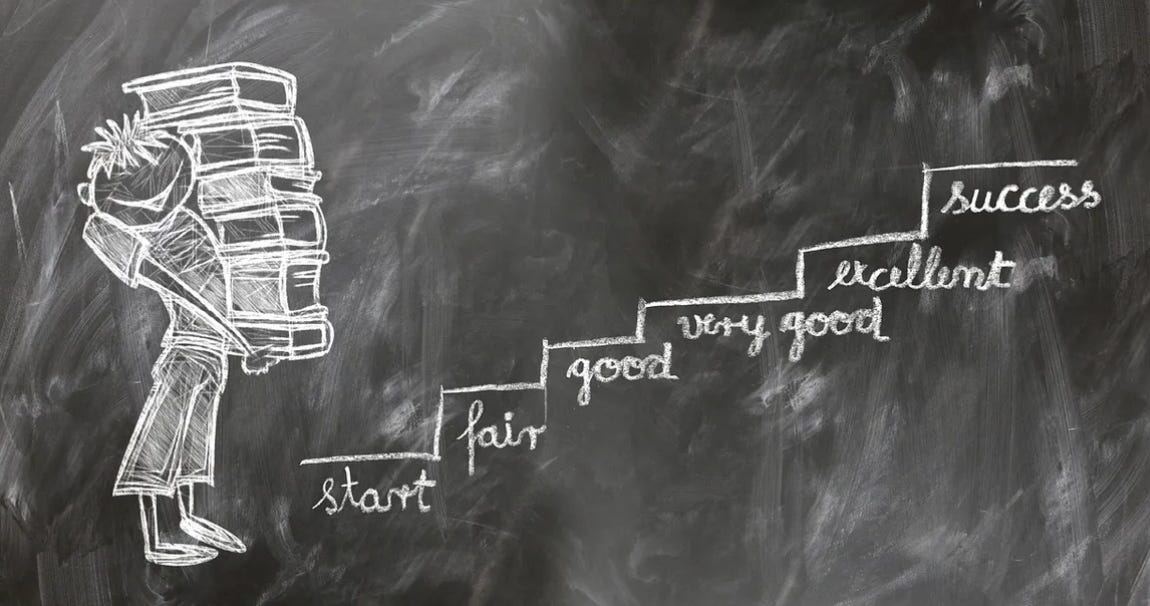
I love this study because it formalizes something that I had intuitively observed in my own classroom for many years. When I started off class with tasks that were challenging for students right away, I could sense student motivation sagging. I would work twice as hard to ensure that students stayed engaged throughout the block compared to classes where I started off with simpler at-bat’s that allowed students to feel successful. For many years I had shared this hard-won knowledge with my colleagues in department meetings, coaching sessions, and PD where I would talk about how I design a Do Now to start off class with a quick and achievable task that allows students to feel successful and gain confidence.
Below is an example of this type of entry level task from my classroom. Students have access to calculators so even if they forget the rule that the angles must add to 90 degrees, they could figure it out by typing each equation into the calculator to see which ones are equivalent. This Warm Up was for a lesson about angles of elevation and depression where it is helpful to take advantage of this rule.

During the PD session, a colleague from a different school shared that she was starting her math class by having students complete 30 minutes of independent work on a computer program called Teach to One. Theoretically computer-based programs like IXL, Math Academy, Teach to One, etc. are designed with the remembered success effect in mind because they start with easier problems that should be achievable for students and build from there. Recent articles about Alpha School like this one from Michael Pershan describe a similar design where students start with basic skills and work their way up a hierarchy of more complex content as they show mastery.
The EdTech Purpose Problem
EdTech programs have been around for quite a while now. I was visiting a friend in LA this week who is a former teacher and literacy coach, and we were comparing notes about how frequently school administrators turn to EdTech products to save the day when schools or teachers are struggling and how disheartening it is to see a rush to invest in these product rather than investing in better teaching. Recently the fervor for these products has seemed to increase with new tools that incorporate AI being launched seemingly round the clock.
Dan Meyer recently shared this idea that he attributed to education historian David Labaree that disagreements about pedagogy are really disagreements about purpose (I’m paraphrasing). I haven’t been able to stop thinking about it because it feels like a particularly important sentiment for this current moment in education. The purpose of most AI-driven computer-based math programs is not to build our students toward challenging thinking or problem-solving tasks. More often the stated purpose is to help students acquire content skills as quickly as possible. This is a purpose that I fully support in the context of practice sessions or tutoring, but I see this purpose as being fundamentally different from the purpose of the questions that I use to launch my class each day to harness the remembered success effect.
The Purpose of Math Class
I believe something bigger may be lost when students enter into their math classroom and immediately dive into individualized practice and instruction on a laptop. I wrote in an earlier post about how a major component of the Common Core State Standards is the Standards of Mathematical Practice. These are not some random add-on to the content standards but rather a core component of what students are expected to develop throughout their K-12 mathematical journey. They can be thought of as habits of strong problem solvers, and in order to work on these habits, students must engage with the types of challenging rich tasks that require problem-solving skills. The remembered success effect can be seen as guidance for how teachers can design a sequence of tasks in a class period so that students are primed and motivated for the problem-solving tasks that will challenge them.
When I think about how to maximize the remembered success effect in my class there are three main aspects of the entry tasks that I prioritize:
Alignment to the learning goals and task format from the previous class period
Data I’ve collected on their mastery to ensure early success
Alignment to the learning goals for today’s lesson
I can guarantee that these tasks are tightly aligned to our curriculum tasks from the prior lessons, so students are clear on how to start. I keep this time super focused by only providing students four total questions to complete, which they can move through at their own pace. We review as a class the common errors and key points that students should take with them into the day’s lesson. Students engage in partner talk to explain how they arrived at solutions or why a common answer is incorrect. This practice prepares students to collaborate effectively with their peers as we head into the more challenging problem-solving tasks in class. Not only is it remembered success, but it is remembering that they are not doing this work alone and that they can receive feedback safely and learn from mistakes.
If we believe in the purpose behind the Standards of Mathematical Practice and the purpose of building strong critical thinkers and creative problem solvers in our math classrooms then how we design the tasks that students engage with from the first 10 minutes to the last 10 minutes of class matters. Sending students off to independent work on a laptop does not replicate the experience of engaging in a shared classroom routine of practice and review through a well-designed Do Now or Warm Up. It does not replicate the experience of tackling a rich problem-solving task with a team of classmates. It may replicate the type of practice that is done in the independent practice portion of a class period or homework or tutoring.
I worry that enthusiasm for the “results” that these programs promise can easily overshadow the limitations of their purpose. Without starting by examining the purpose of the activities and tasks that students engage with during class, there is a risk of losing the core idea of what makes mathematics a truly human endeavor.
The social purpose of your approach feels increasingly important to me. Much of EdTech usage is isolating. The oft-stated vision, to have every student working at their own pace on highly individualized material, a personal tutor for all, is a grey dream. You "review as a class the common errors and key points," and students "engage in partner talk to explain how they arrived at solutions or why a common answer is incorrect." That feels like a place I want to be.