
The case for including inquiry
Why inquiry belongs in the math classroom

Since returning from winter break, my students have embarked on my favorite unit of 10th grade math, Right Triangle Trigonometry. I’m sure anyone reading this can recall learning SOH CAH TOA, and when I talk to adults about Trigonometry, I find that it is one of the math topics that they recall fondly. Trigonometry is beautiful both in its simplicity (at the end of the day, it’s just the ratios of the sides of right triangles) and its widespread applications to everything from architecture to rocket science. It intuitively makes sense to students but can still present a challenge when it’s applied to novel situations. Trigonometry enchants generations of math students because its foundational concepts can be derived with just some basic background knowledge of similarity and right triangles, delivering a depth of knowledge that sometimes eludes students in other topics such as Quadratic Equations or Rational Functions. Even the ancient Egyptians and Babylonians who lacked a concept of angle measure, explored and understood the ratios of sides in similar right triangles, and young mathematicians get to retrace these thought patterns to understand how the ratios unlock the measurements of triangle sides and angles.
Trigonometry is also a perfect illustration of the importance of marrying inquiry-based learning with explicit instruction. Right now seems to be an interesting moment in the omnipresent debate between explicit instruction, which is teacher-led and backed by the science of learning, and inquiry-based learning, which is student-centered and investigative. For years it felt like there was a dominant trend toward inquiry-based learning, but recently the pendulum appears to be swinging back the other way with a renewed interest in explicit instruction and studies that point toward its effectiveness. I’ve been a longtime advocate of combining both types of learning within the math classroom, but I’ve been frustrated by how entrenched the viewpoints can be on each side. One perennial issue in the debate is that it can be challenging to discuss what we even mean by explicit instruction and inquiry-based learning across different subject areas. I cannot speak to the purpose of each in English or Science, but I will strongly advocate for why both approaches are needed in Math. This post will address the role of inquiry, and I will follow up with another post about explicit instruction.
What Inquiry Means in Math
Much of the writing about explicit instruction, especially retrieval practice, focuses on the acquisition of content. This makes sense when we are thinking through the lens of mathematical content standards such as “HSG-SRT.C: Define trigonometric ratios and solve problems involving right triangles”. I can explicitly teach the ratios to my students and assess their ability to determine which ratio to use and set up an equation to solve for a missing piece of information. Students can practice this procedure and gain confidence with it as they progress toward proficiency. However, the Common Core Standards for Math are not just content standards. They also include the Standards for Mathematical Practice which are introduced with this illuminating quote:
The Standards for Mathematical Content are a balanced combination of procedure and understanding. Expectations that begin with the word "understand" are often especially good opportunities to connect the practices to the content. Students who lack understanding of a topic may rely on procedures too heavily. Without a flexible base from which to work, they may be less likely to consider analogous problems, represent problems coherently, justify conclusions, apply the mathematics to practical situations, use technology mindfully to work with the mathematics, explain the mathematics accurately to other students, step back for an overview, or deviate from a known procedure to find a shortcut.
In other words if all we do is explicitly teach students to become fluent with procedures and apply them to replicable problems then our students will likely not become flexible problem solvers who can apply their learning to new situations. For this reason, above all, I believe that students must have planned experiences with inquiry that allow them to develop these practices in a supportive environment and in the context of learning new mathematics.
There are two categories of tasks that particularly work to blend the goals of the Standards for Mathematical Practice with the learning goals of the curriculum. Focusing inquiry-based learning in these specific types of tasks helps to clarify where inquiry is most advantageous so that explicit instruction can still remain a central part of the curriculum as well.
1. Exploration that leads to deriving a key rule or relationship
I’ve launched the Right Triangle Trigonometry unit using the same opening activity for the past 10 years. The lesson starts by explicitly introducing students to how to name and label the sides of right triangles but then opens up to an investigation where students measure the side lengths of a variety of right triangles using rulers with a specified reference angle and divide the measurements to find their ratios. They find the average of the ratios for all the triangles and then fill in a class table jigsaw-style so that each group of students completes a specific angle measure.
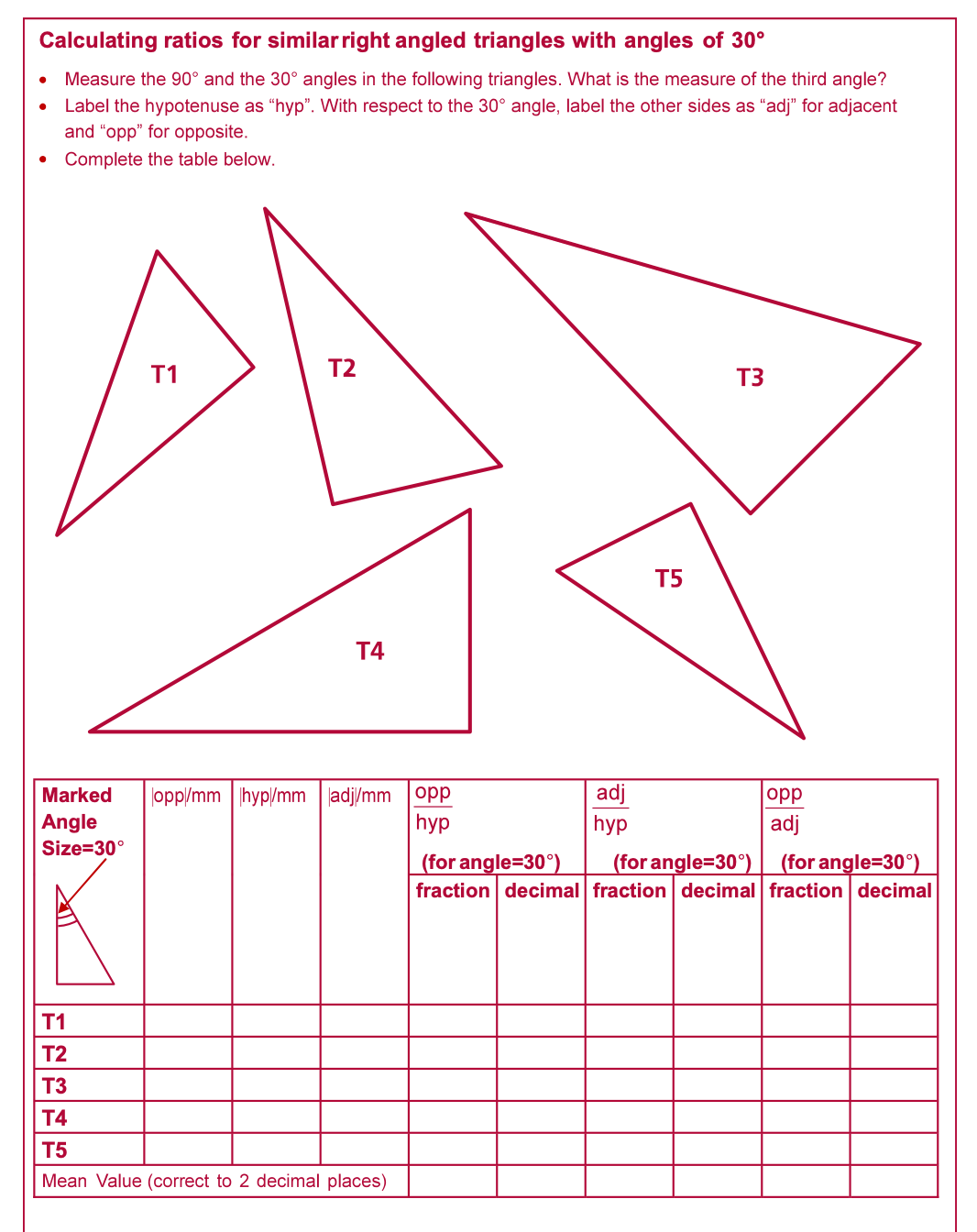
Here is the master table that was filled in by our class:
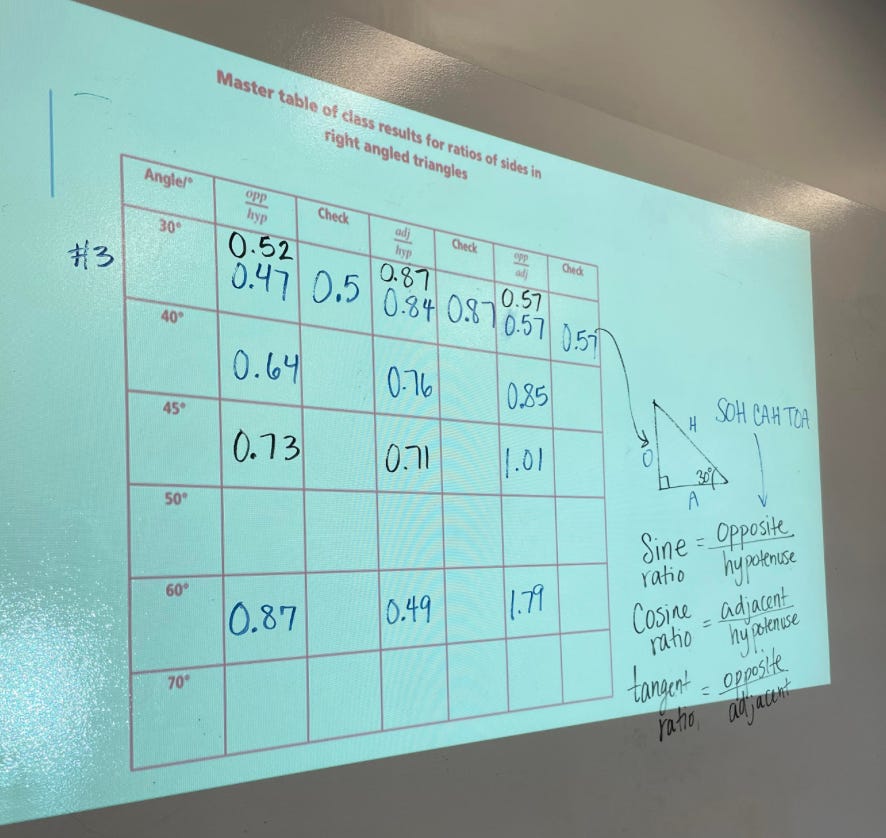
The class discussion leads to students realizing that they kept calculating very similar values for the ratios even though the triangles were different sizes and that this was happening because all of the triangles must be similar due to Angle-Angle Similarity. When students then learn the names of the ratios and check them using the calculator, they are amazed at how close they are to the ratios they found from their measurements. This leads to a deep understanding of where the values of the ratios in the calculator come from. The reason this is important for students to derive rather than being “explicitly told” is because they can then make sense of why the first step to using Trigonometry is to identify a reference angle in the right triangle because the value of the ratio is consistent for any given reference angle and its value depends on the value of the angle. Beyond that, the activity imparts a deep understanding of how mathematicians thousands of years ago determined the values of these ratios so that they could be used efficiently to calculate values in right triangles.
One valid criticism of these types of exploratory derivation-style inquiry activities is that they are overused. I have heard exasperated college-level mathematics professors exclaim that it is ridiculous to ask students to derive laws of mathematics that it took some of the most skillful mathematicians many years to develop, and they aren’t wrong. There are times when this type of lesson could be a whole lot of effort for very little reward and end with students needing an explicit reteaching of the concepts that they should have learned. It’s crucial to know where there are real opportunities in the curriculum to allow students to engage in these types of exploration in a way that can be described as “airtight”. My definition of an “airtight” activity is one where it is nearly guaranteed that almost all students will be able to walk away from the activity with a solid understanding of the main idea.
This trigonometry activity is “airtight” because 10th grade students have the skill level to be able to measure and divide triangle sides with relative accuracy and the number of triangles that they measure combined with the step of averaging the ratios ensures that the final answer is less likely to be skewed by one outlier measurement. Additionally, the most important piece of conceptual prior knowledge is Angle-Angle Similarity which is a major concept from the Similarity unit that precedes Trigonometry and is generally a standard with high mastery.
To summarize the considerations that help determine if an inquiry task is appropriate to explore how to derive a key understanding of a concept are:
How easy is the activity for students to complete independently and accurately?
How long does the activity take to complete?
What level of mastery do students have of the prerequisite knowledge that is needed to grasp the key takeaway?
Will the activity/exploration help students better understand the key takeaway or major concept of the unit?
In the case of the exploration that I use to launch Trigonometry, each of these bullet points is a yes, but there are other units where I have skipped similar types of exploration activities because I have felt that several of the criteria were not met and it would not have improved my students’ learning outcomes. For example, the launch of the Similarity unit includes an activity where students scale a drawing of a snowman by hand. When reviewing this activity I determined that many of my students would be unlikely to be able to complete these accurately and I couldn’t identify how the activity would lead to a key understanding of similarity. It felt like more a time-filler that was meant to make dilations seem fun rather than a purposeful exploration of mathematics. This is one of the major reasons why it is important to not be entrenched in an either-or mindset with respect to inquiry and explicit instruction. The effectiveness of each method is highly dependent on context and the learning objectives of a given lesson or unit.
2. Sense-making and Modeling
Two of the Standards of Mathematical Practice that I have found to be the most important to incorporate into my classroom regularly are MP1: Make sense of problems and persevere in solving them and MP4: Model with mathematics. This is not to pick favorites because I actually believe that all of the standards are important, but these two unlock the ability for students to reach high levels of proficiency and to gain a deeper understanding of the purpose of mathematics (what we might call relevance?). In order to really grow in sense-making, perseverance, and modeling, I have found that students need to have semi-regular exposure to attempting to solve problems that they have never seen before but that they technically have the pre-requisite skills to figure out. There are many ways to provide this type of experience to students, but one of the most effective ways that I’ve found is to launch a new type of problem as collaborative group work after introducing a few key ideas that they could use to solve it.
In my Trigonometry unit I do this on day 2 of the unit where students encounter a problem that could be solved using an equation with the sine ratio. Critically, I ensure that students have never seen an equation with a sine ratio. What they have seen is how to label the sides of right triangles when given a reference angle, how to set up a sine ratio with known side lengths, and how to use a calculator to calculate the value of sine for a given angle. These are all the ingredients they need to make an equation using a sine ratio, but they have never put them together before. Here is the problem that they explore:
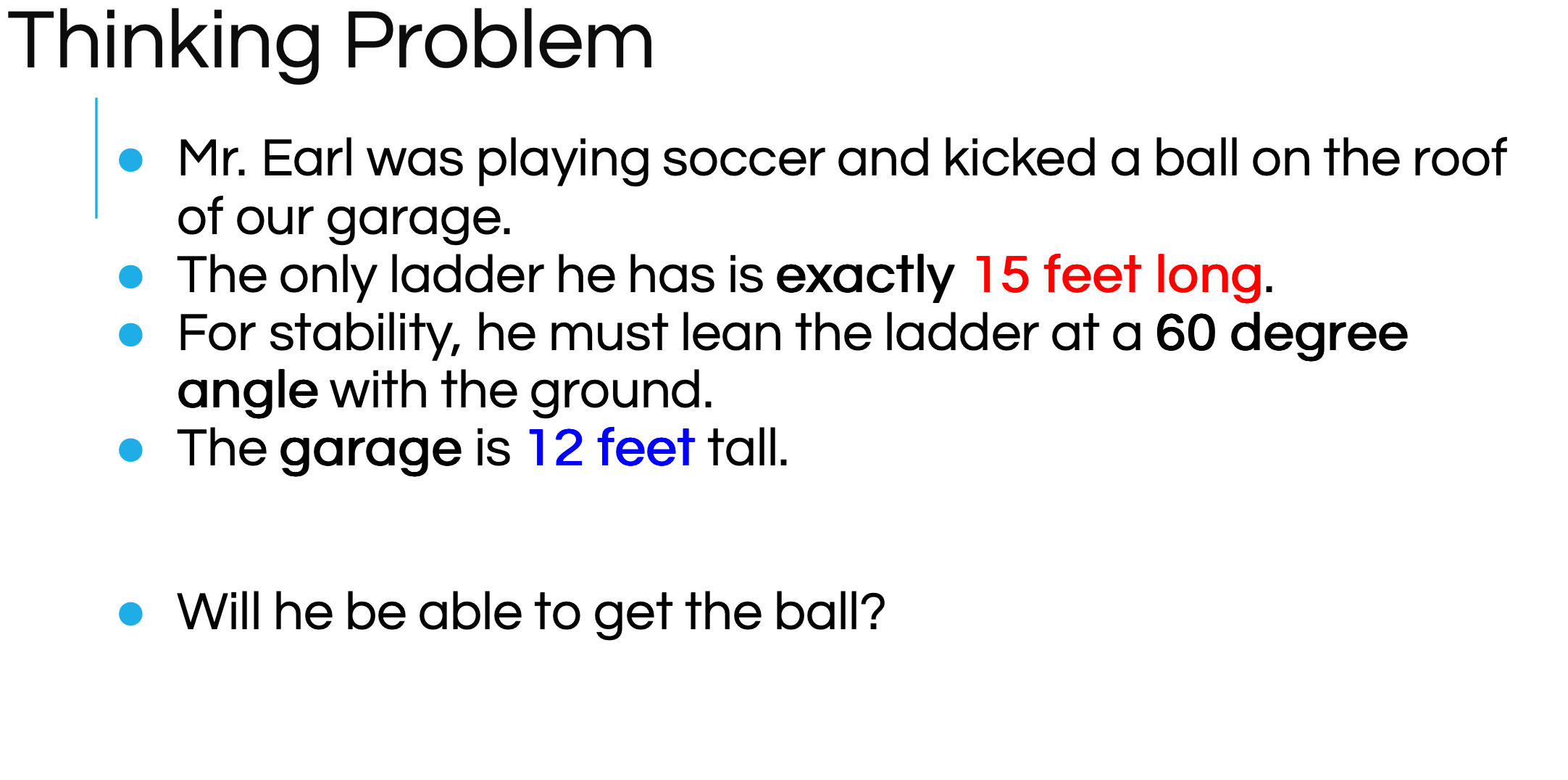
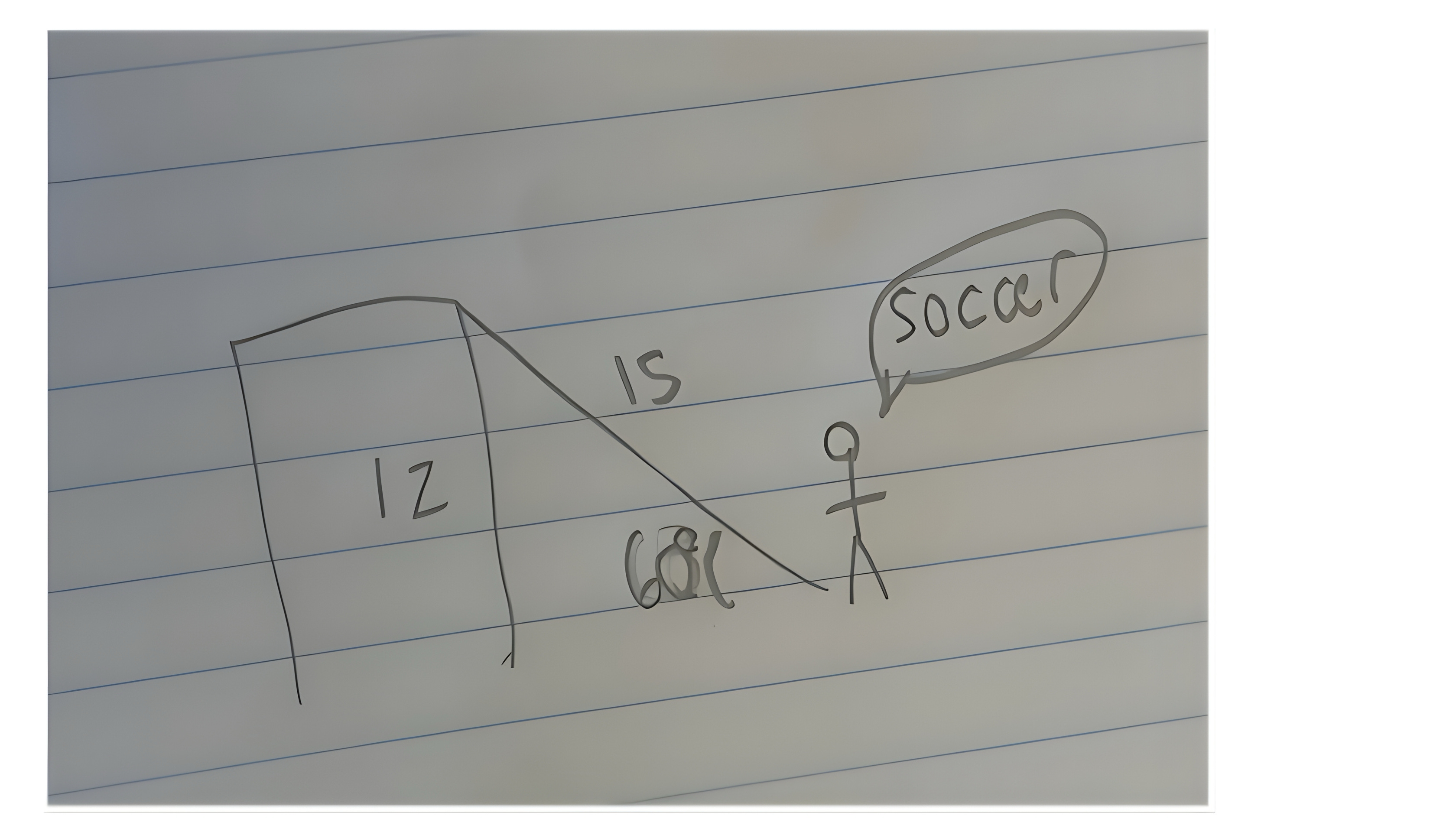
There are some aspects of the problem that ensure that students will get practice with MP1 and MP4. There is no diagram provided, so students will have to make sense of what is happening in the problem in order to visualize the right triangle and where the lengths and reference angle should go. The question is asking them to decide whether he gets the ball rather than directing them to solve for something. This requires students to make sense of what they must solve in order to answer the question. It turns out that this is often the hardest part of the task for students.
In order to ensure that this problem is a success, I always have students attempt to draw a diagram independently in their notebook before collaborating with peers. This ensures that they have multiple rounds of revision in the problem-solving process. During this time I have pre-planned prompting questions that I ask both to the whole class as well as to group and individuals. Some of the important prompting questions for this task are:
Where should you put “x” in the diagram? What are you trying to figure out?
Do we know if the ladder will reach the top of the garage? So do we know if the height of the ladder will be 12 feet?
What type of angle does the garage make with the ground?
What ratio is the sine of 60 degrees the same as?
The prompting questions are key to helping students develop habits of modeling and sense-making, and they also help students persevere when they are starting to get stuck. A key piece of planning for inquiry is determining what prompting questions will help students continue through the problem-solving process when they are stuck and then knowing when to provide these prompts so that they don’t take away from student thinking but allow students to make progress.
By allowing students to attempt this problem without having seen it before, students are given an opportunity to encounter a need for setting up an equation with a trigonometric ratio. They are able to see why that this the only solution path that will work. Many of them will try the Pythagorean Theorem first and then realize that they actually only know one side of the triangle because the height the ladder reaches is actually unknown. This will force them to consider using sine because they know the hypotenuse and want to know the opposite side. Many of them do eventually realize how the ratio’s value in the calculator allows them to create an equation can be used to find the opposite side. The problem also opens up other elements of modeling as some students will consider Mr. Earl’s height in the problem and how that can play a role in his ability to reach the ball. This gives students an opportunity to bring in real-world context to the modeling aspect of the problem.
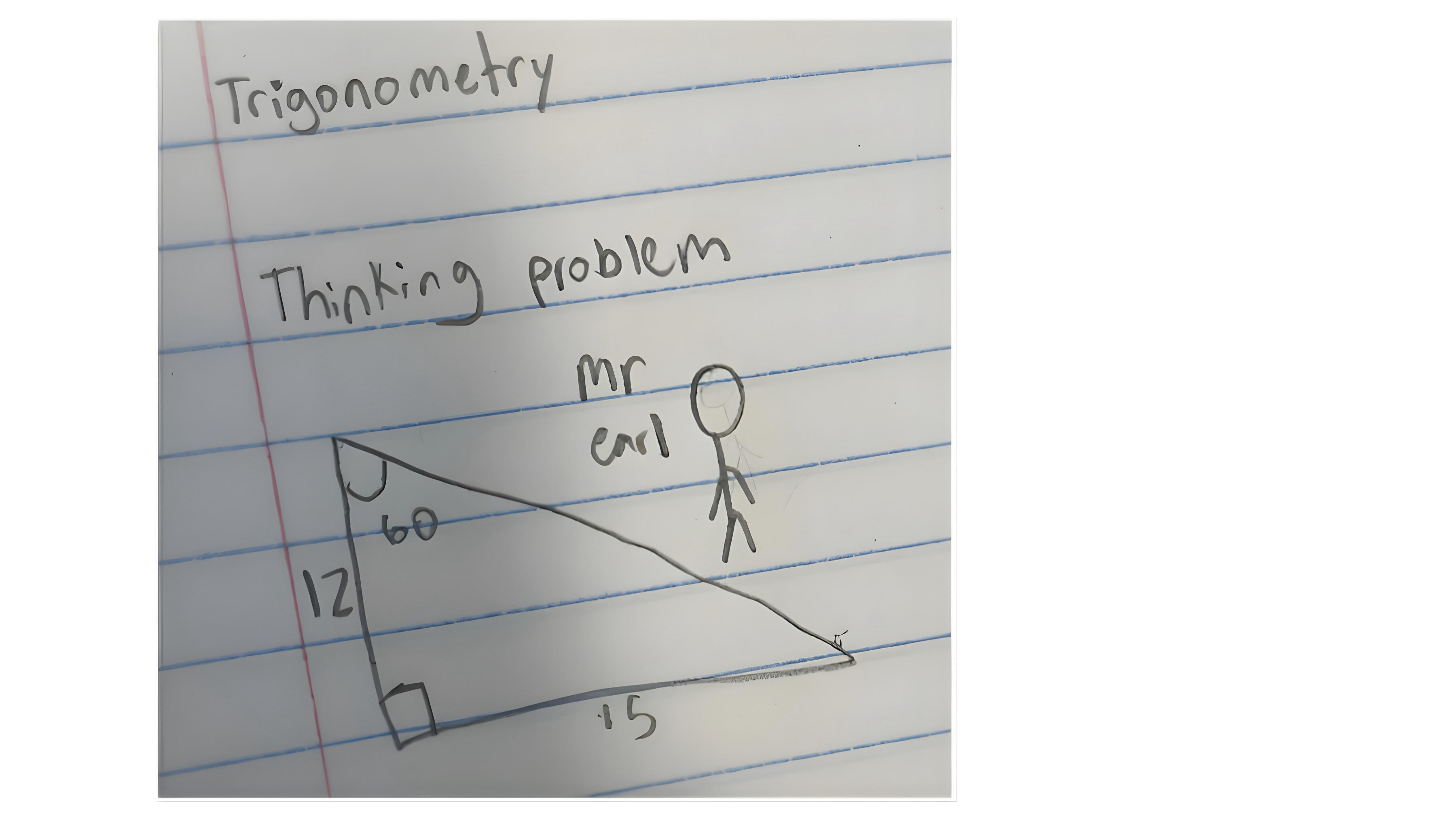
Here are some initial student drawings in the notebook:
Here are selections of student group work on the whiteboards:
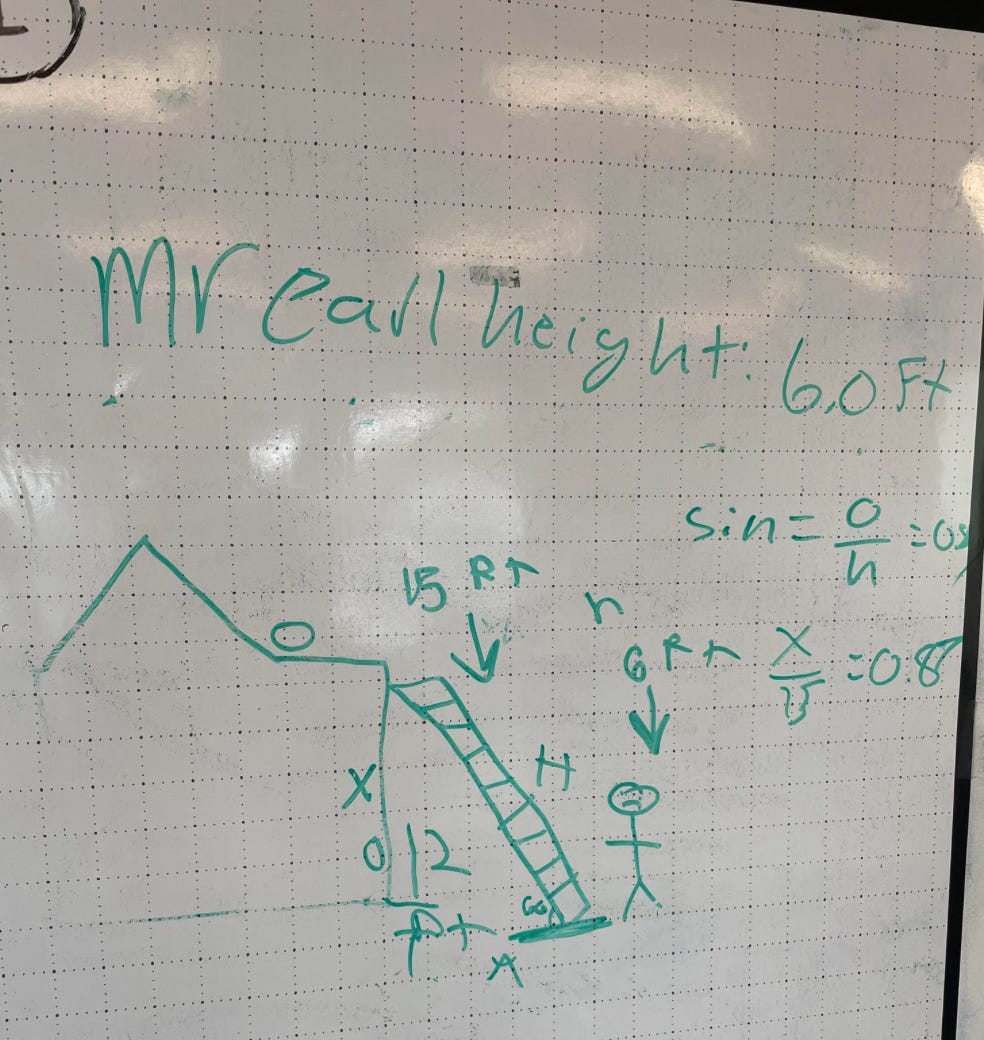
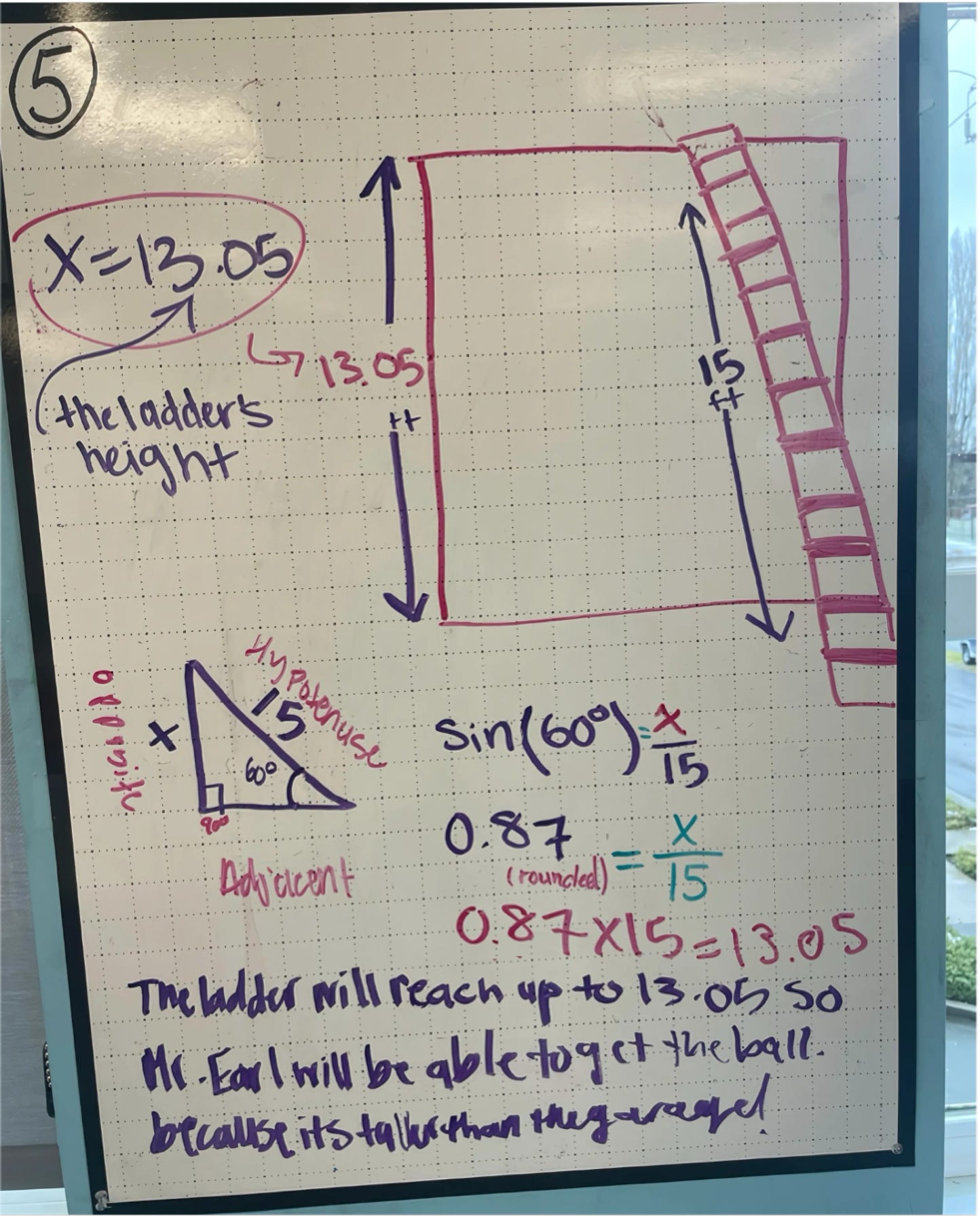
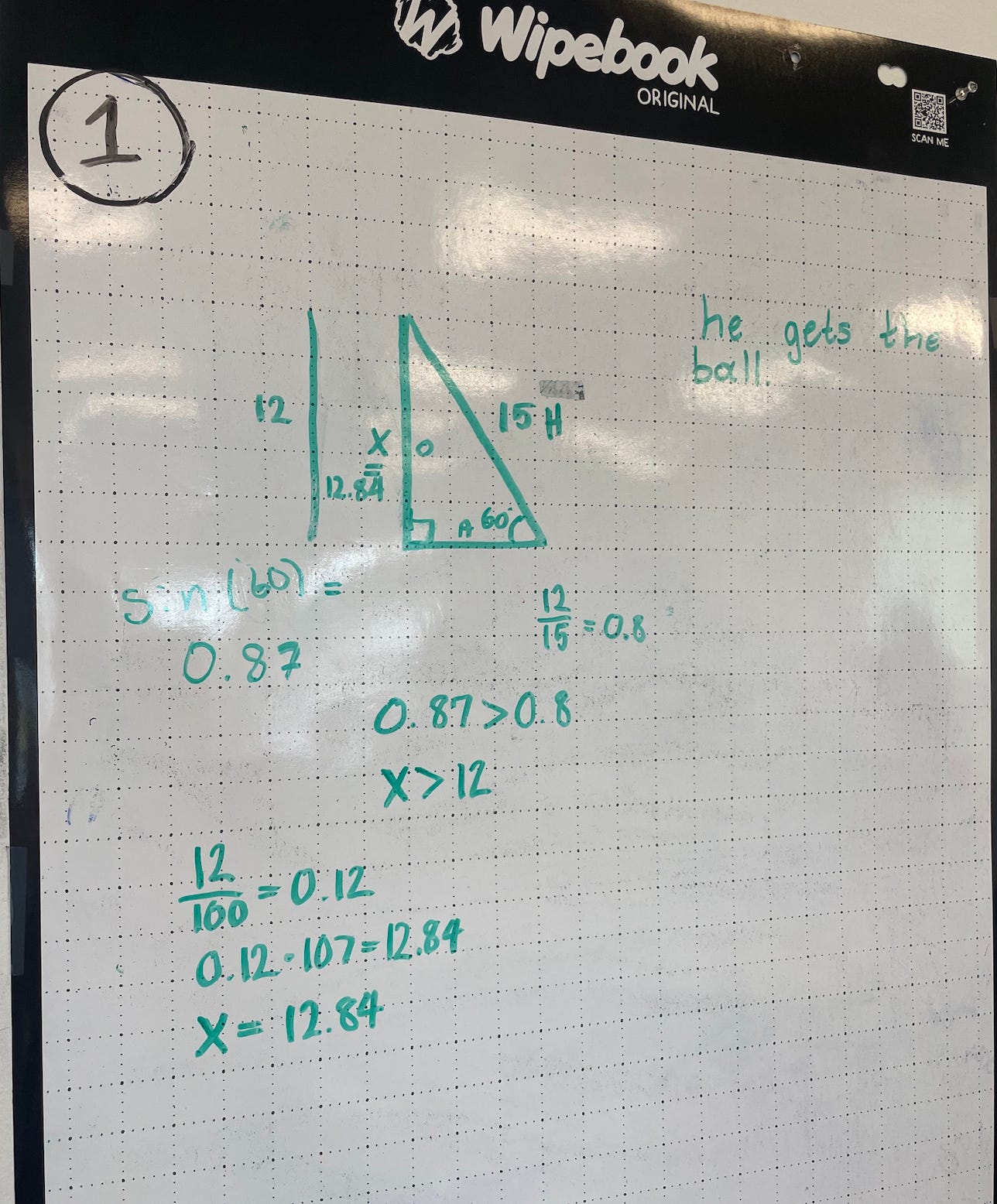
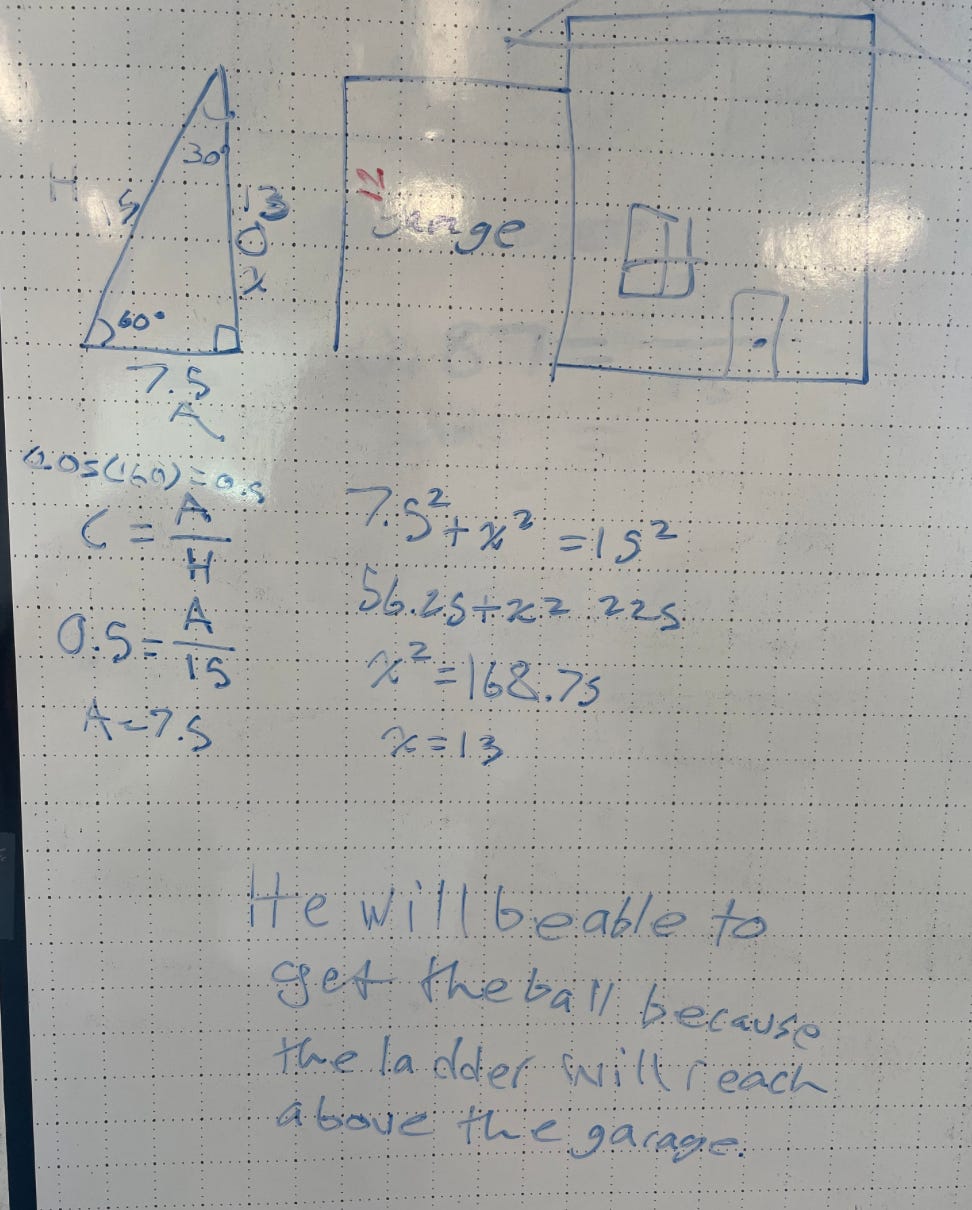
What stands out to me when reviewing the student work is that many of their solutions include interesting errors, incomplete ideas, and partially correct thinking. There is so much to be able to leverage in the class debrief of the problem from what students have produced. I can see what they already know and also what they don’t know yet, which allows me to tailor how I will explicitly teach what comes next to leverage their strengths and attend to their weaknesses. This level of variation in thinking generally only happens when a task is rich enough to elicit creative student problem-solving, and it is critically important to capture both as formative assessment of student problem-solving skills and as a jumping off point of how to get students from their current understanding of how to solve this problem to an understanding of why the correct solution path works. Dan Meyer beautifully describes this as “creating the headache” so that students understand the need for the mathematics, which he calls the “aspirin”. By creating the conditions for students to clearly see the need for the procedure, they are able to make deeper connections to what they will explicitly learn and practice afterwards.
In summary, inquiry tasks that lend themselves to sense-making and modeling have the following attributes:
Students have not encountered the problem type before
The task requires students to make sense of what is happening in the problem
Students are answering a question rather than solving for a designated value
There are multiple solution paths or ways of approaching the problem
Students have all of the requisite ingredients or knowledge to be able to reach a solution even though they have not completed a problem like it before
There is a real-world context that requires modeling skills
These types of problems often exist within curriculum materials but sometimes they are overly scaffolded or placed after instruction to be used as “application” problems. One effective way to offer this type of inquiry experience to students is to flip the order of the lesson and remove some of the scaffolding from the problem. It is still important to ensure that students have enough context and root skills to be able to engage with the problem. It is also key to plan clear prompting questions and to know when to bring students back to debrief solution paths. One mistake that I often see teachers make is to allow the inquiry task to go on for too long and to go group by group to teach students how to get the correct answer. As is evident in my students’ work above, it should be expected that not all students will arrive at the correct solution. The goal of the task is to foster problem-solving skills and elicit student thinking, not to get a right answer right away. All students should achieve clarity and understanding of the solution path through the whole class discussion and debrief that happens when the class comes back together at the end of group work. Ideally, this debrief then leads to explicit instruction and practice of the skills embedded within the inquiry task.
What holds inquiry back
Inquiry learning often gets a bad reputation because of its overuse and lack of structure. There are many learning goals and lesson tasks that are not compatible with inquiry, and forcing these tasks into an inquiry format will generally not produce the learning outcomes intended. Beyond that, one of the biggest problems that I see is mistaking unstructured learning for inquiry learning. The most effective inquiry learning is highly structured. As in the example above, this includes multiple rounds of engagement with a problem that are chunked as independent work, group work, and collaborative discourse. The teacher is prepared to guide student thinking with prompting questions and facilitate engagement with routines and norms as needed to ensure that students are building habits of perseverance and sense-making.
Inquiry depends on high levels of student engagement in order to produce the intended results, but it is also cognitively demanding for students. This means that it must be chunked into manageable timeframes that don’t overload student thinking. Most of the inquiry tasks in my classroom last no more than 15 minutes, and some of them are as short as 5-10 minutes. Within that timeframe there are frequent check-in’s and shifts in the modalities of student engagement to ensure that students are receiving feedback both on the content of their solutions and on their level of engagement. Most of the feedback is positive and directing students toward what to do rather than what not to do. When I walk into a classroom where inquiry is falling flat I tend to see the opposite of this. The teacher circulates haphazardly and students are relatively disengaged and confused. It turns into whack-a-mole as the teacher goes student to student or group to group and tries to get them back on track. This doesn’t mean that inquiry doesn’t work. It means that inquiry without purpose and structure doesn’t work.
Brilliant breakdown of when inquiry actually works vs when it becomes performative. The "airtight" criteria totally changed how I think about task design,especially the bit about chunking cognitive load into 5-15 minute blocks. Had a similar experence with my AP stats class where students tried multiple approaches to confidence intervals before we formalized it. That struggle phase seems key but only if the payoff lands cleanly afterward.
Great post! I agree that being confident students can accurately complete the "intermediate steps" is key for an inquiry lesson. I've taught lots of inquiry lessons that fell apart because of accuracy issues. I also agree that inquiry needs to be highly structured to work and that's a common misconception.
I think another element at play re: sense-making is trust. Whether you're using explicit teaching or inquiry, if the teacher regularly asks students to do things that are well beyond their abilities or end up feeling confusing, they lose trust. If lessons are well-structured and students see that teaching reliably leads to learning, they gain trust. That trust is key for students to make sense of challenging mathematical ideas.